Let’s leave aside the familiar: the biographical context, the film’s place in the director’s oeuvre, or its festival history. Holy Motors offers an experience akin to meditation or a dream, from which one emerges with a sense of shifted reality. Let us attempt to understand the film’s inner workings — not by evaluating it, but by listening closely to its own voice.
Rewatching Holy Motors in 2025, one is struck by how in tune it feels with the present moment. In the film’s booklet, Carax wrote: “It is about people, monsters, and machines on the verge of extinction,” and today that sense of a decay of familiar world has become almost physical. His metaphors have taken on technological flesh. What ten years ago was a discourse on the nature of the image has become everyday reality: neural networks generate faces and entire worlds. With latest writers’ strikes and news about actors’ digital avatars, the film’s central question sounds with new force: what remains of the human being when their roles — from creator to worker — become mere “assignments” within someone else’s algorithm, and any attempt to break free from the role is doomed from the start?
The film’s logic is present not so much in the plot as in its pulsation — in the rhythm of shifting masks, in the painful amplitude from grotesque to tender. It may seem that this rhythm offers a sinister perspective: the world breaks down into episodes, and the human being into images, much like the chronophotography of Étienne-Jules Marey — the 19th-century French physiologist whose experiments became film interludes — reduces living movement to a set of mechanical phases. But this authorial detachment is more a testament to vulnerability and merely a starting point.
The Monster and Glamour: A Quiet Connection
The repulsive creature Monsieur Merde crawls out of the cemetery shadows straight onto a film set — into the sterile space of glamour. This world operates as a system of filters: camera, concept, “humanity.” The model, photographer, “beautiful!” — all of this is a ritual for producing a simulacrum of beauty. Merde acts in the opposite way. He methodically strips away whatever is superfluous, whatever gets in the way: he bites off the assistant’s two fingers, as if erasing the quotation marks themselves; he tears the filter off a cigarette; he eats money and flowers which are just surrogates of value and life.
He drags the model into his underground lair — not to make her his hostage, as the viewer expects, but to free her from another, far more encompassing captivity. The captivity of her own image, which blinds the spectator, and prevents them from seeing a human being behind the canon of glamour. That is why Merde fussily assembles a kind of veil for her, neutralizing the image and leaving us only her gaze. And now, when the totality of the image has been destroyed, we finally see fatigue in models eyes — the exhaustion from the endless obligation to be visible, correct, fashionable. It seems the actress feels relieved.
Then Merde lays his head on the model’s lap, and she begins to sing him a lullaby — a tuning of sorts, a moment of reconciliation. The scene unfolds on a new, deeper level — as a synthesis of two poles of the actor’s craft. Monsieur Merde embodies wild, bodily improvisation — pure impulse — while the model represents hollowed-out, staged visuality. In this moment, the two seemingly hostile logics stop fighting and begin to search together for the true source of beauty.
The model ceases to be an object and becomes a participant in intimacy. It is precisely the acting born from this union that restores living substance to the entire scene — the very authenticity that gloss can only appropriate, but never create.
Falling into Reality
The encounter with Kylie Minogue’s character is yet another attempt to break through the fabric of representation. Her “let’s not talk” sounds like an invitation to step out of the matrix of roles, where every word is already a script, every line constructed for engagement. But refusing one script only marks the beginning of another: the music starts, the camera moves in, the character sings. And again, the paradox: the performance, pushed to deliberate exaggeration, brings one closer to reality. Sincerity proves not to be a rejection of performance, but its pinnacle.
Two characters stand on the roof of the abandoned department store “Samariten” — witness to The Lovers on the Bridge — and her song becomes a requiem for what they could have had. We begin to understand something else about the world of Holy Motors: approaching the real is truly dangerous. When she jumps from the roof, death is felt “for real” for the first time in the film. And so are Oscar’s tears in the limousine. Step beyond the perimeter of the stage, cross the line where performance stops recognizing itself as performance — and you pay with life.
As the Other and an Endless Cycle
But if stepping beyond the stage threatens death, the performance itself drives the metaphysical toward disappearance: Monsieur Oscar kills his own double. First, in the role of a criminal, he finds his victim — a man resembling him like a twin brother. He plunges a knife into the man’s neck, and instead of concealing the traces, he amplifies the likeness: dressing and applying makeup to the dying man, transforming him into his absolute double. And when the copy is ready, the original suddenly literally becomes its victim. Identity is not merely blurred — it is annulled in a bloody ritual, where it is already unclear which of the two, bleeding, somehow returns to the limousine. Reality and its image merge beyond distinction, leaving the spectator in disorientation.
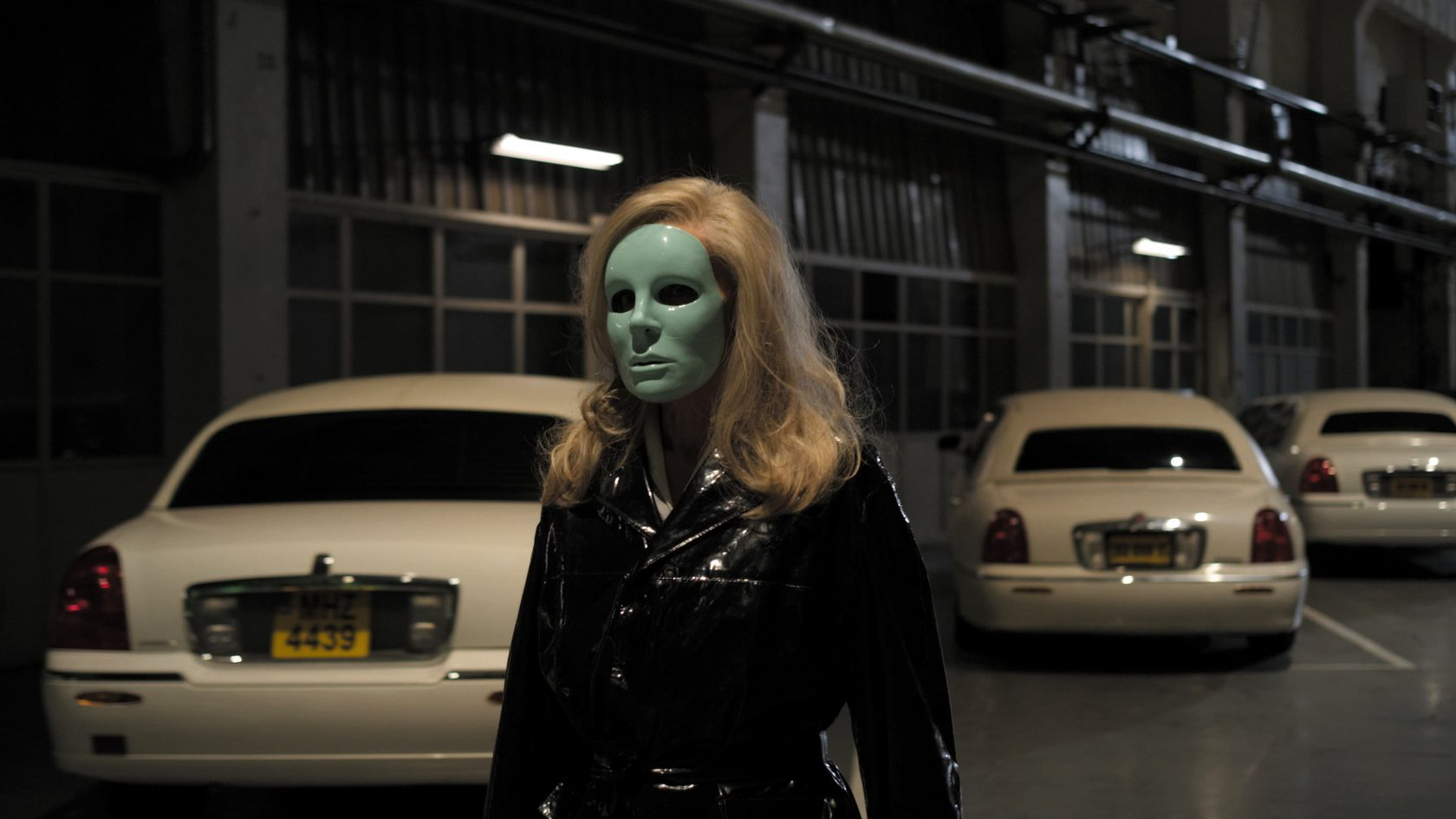
This hermetic nightmare is the dissolution of the “I” into the Other. But there is another process — the rebellion of the “I” against itself. We see Oscar in the role of a successful banker — the embodiment of order, capital, the system. Later, already in the guise of a masked avenger, crowned with a metal crown of thorns, he shoots at the banker, as if hunting the image that escaped from the limousine and began to live its own life. Security rushes in and fires back. Bleeding, Oscar screams frantically: “Aim for the groin!” This cry is not merely a desire to die, but a thirst to destroy the very generative principle — the central symbol that assigns all roles. It is a demand to break the chain of reincarnations. But the system does not relent. The driver Céline appears and drags the actor back.
The roles we play split the “I” into separate figures that start acting against each other. The criminal, merging with his victim until they are indistinguishable, the banker, protecting the old world, and the revolutionary, destroying it — are different stages of the same cycle. The one who breaks the order inevitably becomes the new order. In this world, “taking off a mask” only means putting on the next one. Because beyond roles and symbols, there may be nothing at all.
The Camera as the Last Religion
They say beauty is in the eye of the beholder. But what if the beholder is gone? Oscar notices with despair: the cameras have become so tiny that he no longer trusts himself. While you are being “filmed,” there is a frame, a form, a ritual — you understand who you are. Once the observer disappears, the contours of meaning collapse. A Nietzschean void sets in, where you must define yourself, and that is scarier than any role. That is why the suggestion to “quit working” sounds like an offer of death, and Oscar refuses.
Here there is no calm “outside,” only movement. This is the film’s paradoxical answer: authenticity is not a fixed core hidden beneath masks, but the movement between them. The conversation of limousines in the garage echoes this theme: the cars complain of their own uselessness, realizing they are fading into the past along with humans and film. Total refusal of a role is not freedom, but nonexistence. Salvation lies not in removing the mask, but in wearing it in a way that leaves a gap. The very ability to change roles is the last freedom, preventing complete absorption into any of them.
Whether the ending offers consolation is unclear. Oscar stands on the threshold of “his home,” smoking to a song whose words sound like a sentence: “The time to rest hasn’t come yet, you must again and again do what you love…” But continuing does not mean merely surviving out of fear. Perhaps this is the actor’s sacrifice, the devotion to the “beauty of gesture,” even if the reward is solitude on the threshold. After all, the “book of life,” even when clear, still “grimaces.” And the task is not to erase that grimace, but to turn it into art — so that through makeup, silicone, and avatars, the same tired, unbroken, melancholic gaze still shines through.